

2026 WNBA Mock Draft

Christian Conway
April 13, 2026
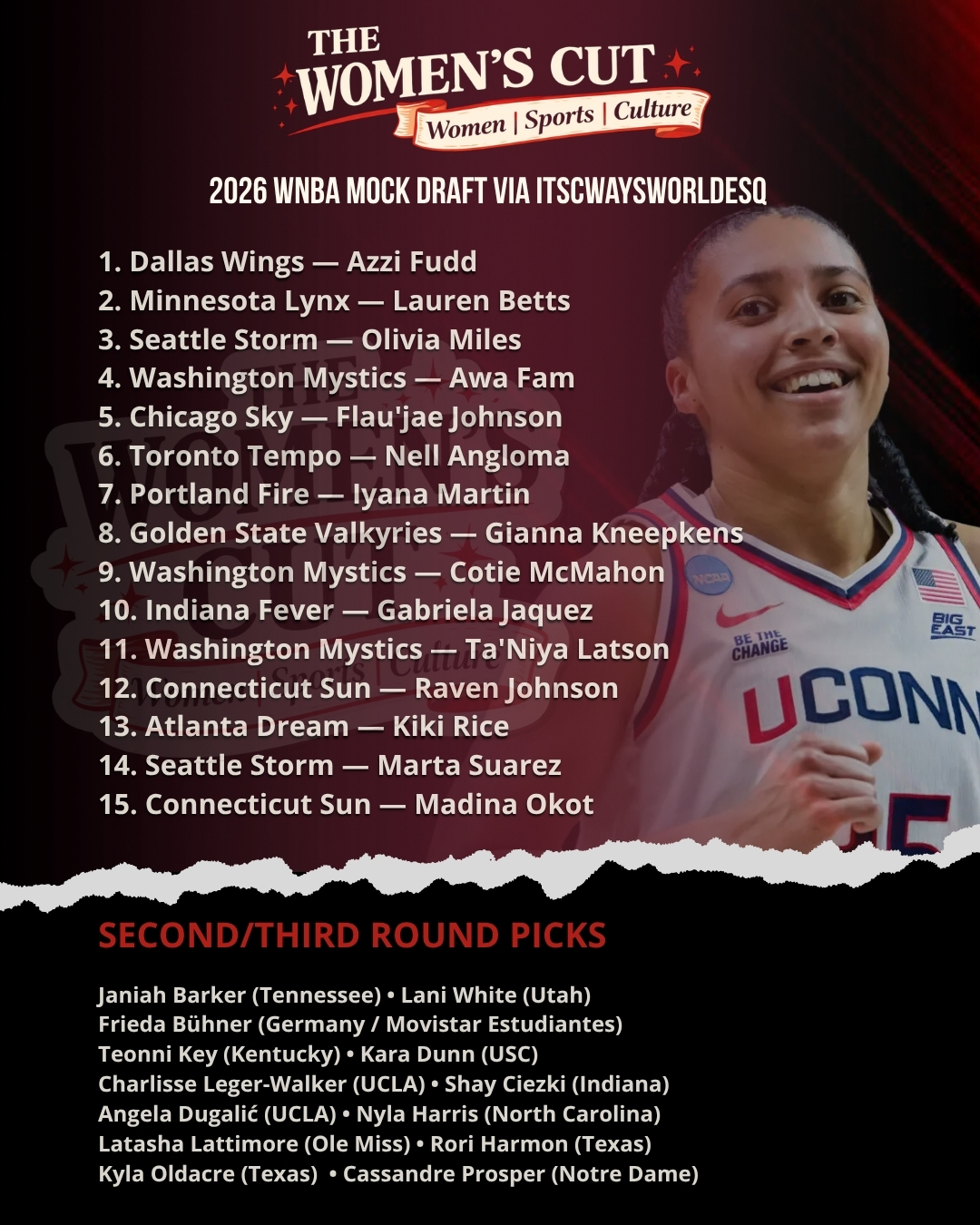
1. Dallas Wings — Azzi Fudd
UConn | SG | 5'11"
Dallas isn’t guessing here—they’re addressing a clear weakness.
Last season, the Wings finished near the bottom of the league in both three-point volume and efficiency. That kind of spacing issue limits everything offensively. Azzi Fudd directly changes that equation.
She averaged 17.3 points per game while shooting 44.5% from three on high volume—elite efficiency that translates immediately. Her ability to operate both in spot-up situations and off movement actions puts constant pressure on defenses, especially in quick decision windows.
According to Synergy tracking, her efficiency in spot-up and off-screen actions ranks among the best in this class, reinforcing what shows up on film—she doesn’t need the ball to dominate a possession, but she still dictates defensive attention.
That matters even more after Dallas added Alanna Smith and Jessica Shepard. Smith gives them a defensive anchor and versatility in the frontcourt, while Shepard brings interior scoring and physicality. With those additions, the frontcourt is stabilized—the missing piece is perimeter shooting.
Fudd opens everything up. Cleaner post entries. Wider driving lanes. More space for their bigs to operate.
Dallas had a spacing problem. They draft the best shooter in the class to fix it.
2. Minnesota Lynx — Lauren Betts
UCLA | C | 6'7"
Minnesota goes with size, production, and control.
Lauren Betts is a playmaking big, not just a traditional post presence. At 6’7”, her decision-making stands out—she recognizes defensive pressure early, processes quickly, and either makes a decisive move or finds shooters on the perimeter.
She’s coming off a dominant NCAA Tournament run, where she averaged 21.0 points, 9.3 rebounds, and 2.8 blocks while shooting 68.8% from the field. Her efficiency around the rim (near 70%) and strong post-up production reinforce her ability to anchor an offense.
Minnesota’s frontcourt has shifted, creating a clear need for a long-term interior presence. Betts fills that immediately.
Pairing her with a young core gives the Lynx a foundation piece inside—someone who can score efficiently, protect the rim, and facilitate out of the post.
This isn’t just replacing production—it’s establishing identity.
For Washington, this is a bet on development, versatility, and long-term impact.
3. Seattle Storm — Olivia Miles
TCU | PG | 5'10"
Seattle gets its new floor general.
Olivia Miles has elite vision. She doesn’t just see the next pass—she sees the play developing multiple steps ahead. Her ability to draw defenders and deliver the ball at the exact right moment separates her.
In ball screen situations, her reads are advanced. She manipulates defenders, controls pace, and consistently creates advantages.
Seattle lost its floor general in Skylar Diggins, and with a younger core forming, the need for structure is clear.
Miles provides that.
She brings tempo control, playmaking, and the ability to organize an offense in ways that allow others to thrive. This isn’t just filling a position—it’s resetting how Seattle plays.
For Washington, this is a bet on development, versatility, and long-term impact.
4. Washington Mystics — Awa Fam
Spain | C | 6'4"
Washington takes a long-term swing.
Fam won’t turn 20 until June, but she already has years of professional experience in Spain’s top league. She’s produced against high-level competition and continues to show development each season.
She’s averaging solid production with Valencia and has already competed against WNBA-level talent internationally. Her versatility stands out—she moves well, defends in space, and flashes playmaking ability.
This is where the draft becomes about projection.
At this spot, teams are weighing immediate production versus long-term upside. Players like Lauren Betts may offer a higher floor, but Fam offers a different ceiling.
For Washington, this is a bet on development, versatility, and long-term impact.
5. Chicago Sky — Flau’jae Johnson
LSU | SG | 5'10"
Flau’jae Johnson is one of the most talented wings in this class.
Her season had ups and downs, but her ability is undeniable. She showed clear growth as a shooter, finishing the season near 40% from three, while also expanding her playmaking and overall offensive impact.
Her NCAA Tournament stretch highlighted her scoring ability, showing she can step into big moments and produce efficiently.
She plays with energy, embraces physical matchups, and brings defensive intensity on the perimeter.
She might actually benefit from the next level.
Chicago… is still figuring things out. But Johnson’s ability travels regardless of situation.
6. Toronto Tempo — Nell Angloma
France | SF | 5'11"
Toronto goes with upside and versatility on the wing.
Nell Angloma has been producing at a high level in France, averaging 15.5 points and 5.6 rebounds while continuing to expand her offensive game. She won’t turn 20 until June, but she’s already comfortable playing against professionals.
She brings positional flexibility, with the ability to play either the two or the three. Offensively, she’s aggressive downhill and can create her own shot, while defensively she has the tools to guard multiple positions.
For an expansion team like Toronto, this is about adding players who can grow into roles. Angloma fits that timeline—young, productive, and still developing.
7. Portland Fire — Iyana Martin
Spain | PG | 5'8"
Portland adds a young guard with real experience.
Iyana Martin has already competed at a high level internationally and continues to produce in Spain’s top league. She’s averaging 14.8 points and 4.2 assists while playing with composure well beyond her age.
She was also the MVP of the FIBA U19 World Cup, which speaks to both her talent and her ability to perform in high-level environments.
For a new franchise, getting a guard who can handle, create, and control pace is critical. Martin gives Portland a foundation piece in the backcourt with room to grow.
8. Golden State Valkyries — Gianna Kneepkens
UCLA | SG | 5'11"
Golden State adds shooting.
Gianna Kneepkens is one of the most reliable perimeter shooters in this class. She shot 42.9% from three this season and over 43% across her college career, showing consistent range and efficiency.
After transferring to UCLA, she proved she could contribute within a more talented system while still maintaining her identity as a shooter.
Her value is straightforward—spacing.
For a Valkyries team continuing to build its offensive identity, adding a player who can stretch defenses immediately gives them a clear benefit.
9. Washington Mystics — Cotie McMahon
Ole Miss | F | 6'0"
Washington adds scoring and physicality on the wing.
Cotie McMahon took a step forward offensively after transferring to Ole Miss, averaging a career-high 19.5 points per game. She also showed growth as a playmaker, adding 3.0 assists per game.
Her game is evolving.
At the next level, she’ll continue transitioning into more of a perimeter role, where her ability to handle, create, and attack off the dribble becomes even more important.
She plays with strength, embraces contact, and brings a scoring presence that Washington can develop alongside its young core.
10. Indiana Fever — Gabriela Jaquez
UCLA | G/F | 6'0"
Indiana adds a player who impacts winning in multiple ways.
Gabriela Jaquez was a key contributor on UCLA’s championship team, averaging 14.3 points, 5.4 rebounds, and 2.0 assists. Her efficiency stands out—strong finishing inside, reliable shooting from three, and consistency at the free throw line.
She doesn’t need high usage to be effective.
Jaquez defends, rebounds, moves the ball, and consistently makes the right play. For a Fever team continuing to build around its core, she fits as a connective piece who raises the floor of the group.
11. Washington Mystics — Ta’Niya Latson
South Carolina | G | 5'9"
Latson is one of the most proven scorers in this class. A former Division I scoring leader, she consistently gets into the paint, draws fouls, and creates offense under pressure.
Her development at South Carolina wasn’t just about scoring—it was about efficiency, decision-making, and rounding out her game.
For Washington, she gives them something different: a guard who can generate offense when structure breaks down.
13. Atlanta Dream — Kiki Rice
UCLA | PG | 5'11"
Rice brings poise, strength, and decision-making. She processes quickly and plays through contact, which fits well alongside a roster that already has scoring options.
14. Seattle Storm — Marta Suarez
TCU | F | 6'3"
Her ability to stretch the floor and produce in high-level moments gives Seattle another versatile forward who can contribute without needing high usage.
15. Connecticut Sun — Madina Okot
South Carolina | C | 6'6"
Her development timeline is still early, but her physical tools, rebounding, and defensive presence give her long-term upside as a frontcourt piece.
HONORABLE MENTIONS (ROUND 2 & 3)
Janiah Barker (Tennessee)
Lani White (Utah)
Frieda Bühner (Germany / Movistar Estudiantes)
Teonni Key (Kentucky)
Kara Dunn (USC)
Charlisse Leger-Walker (UCLA)
Shay Ciezki (Indiana)
Angela Dugalić (UCLA)
Nyla Harris (North Carolina)
Latasha Lattimore (Ole Miss)
Rori Harmon (Texas)
Jessica Timmons (Alabama)
Kyla Oldacre (Texas)
Cassandre Prosper (Notre Dame)
Laila Phelia (Syracuse)
Jalyn Brown (Michigan State)
Discover more from The Women's Cut Sports Media
Subscribe to get the latest posts sent to your email.